
26th of Eleasis of the year 1492
The Heat Beneath the Earth
Deep within the fire temple’s lowest level, the party found themselves suffocating in both heat and uncertainty. As the echo of their last battle faded into the haze of sweltering air, the grim weight of prophecy pressed down. According to their best information, the world would end in four to six days—perhaps fewer—if the elemental portal was raised to the surface. “You’re standing on the cone,” ISAC remarked, comparing their current position to being inside a volcano just days before its eruption. The fire cult’s plan wasn’t just symbolic; it was literal. The portal’s emergence would rupture the world from below, turning this deep cavern into the fiery throat of annihilation.
Exhaustion gnawed at the party like a second curse. Each movement grew heavier, each exchange more brittle, as the toll of their journey bore down on body and spirit alike. The signs of fatigue were undeniable—slowed reactions, dulled focus, and quiet stumbles. Yet it was the lingering fire cult curse that weighed most heavily on them. It clung like ash to the soul, disrupting their connection to the arcane and the enchanted. Spells faltered unpredictably, and once-reliable relics acted with eerie hesitation or backlash. A few among them had managed to shrug off the curse’s grip, but for the rest, even their own powers could no longer be trusted.
In the quiet aftermath, their attention turned to the fire cult’s missing commander. He had fled during the chaos by magical means, vanishing before anyone could stop him. As the group recounted the clues and the contents of the letters they’d found, it became clear that he hadn’t run blindly—he was likely heading toward something specific. “He’s obsessed with the colossus,” someone observed. The idea arose that he might not have gone far at all. Perhaps he was hiding nearby, watching and waiting for the party to clear the way so he could seize the chest or whatever secret lay beyond.
But chasing him down without a trail risked wasting precious time. Some argued that he might have teleported to safety or reinforcements, while others suspected he lingered just out of sight, waiting to strike at the worst moment. Even if they chose to pursue him, the terrain was vast, the heat debilitating, and their resources running thin. There was no guarantee he could be found, let alone cornered. A balance had to be struck between pursuing a fleeing enemy and preserving themselves long enough to stop the greater threat.
That left only one viable conclusion: rest was imperative. Without it, they would crumble before the true battle began. But resting in the heart of a hostile fortress, beneath a sky of glowing orange lichen and walls that pulsed with molten heat, wasn’t simple. They’d need to scout for defensible locations, assess their surroundings, and find a way to secure themselves—if only for a few hours. The tension did not lift. It only paused. The danger remained, not just beyond the doors of the fire temple, but within the party’s own trembling bodies and spell-weary minds.
The Cavern Revealed
When Ace stepped beyond the threshold, he found that they hadn’t been fighting in a mere chamber but inside a freestanding building nestled within a vast subterranean cavern. The air outside was thicker and hotter, heavy with minerals and the breath of ancient fire. Above them, the cavern ceiling rose nearly eighty feet, glowing with the light of phosphorescent orange lichen that clung to stone like a second sky. The light shimmered in a false twilight, made stranger by the occasional pulse of deeper reds and volcanic golds that glowed faintly to the north and northwest. The temperature climbed sharply upon exiting, easily ten degrees hotter than the sweltering room behind them.
The ground was a patchwork of rough stone and dust, broken by half-buried tracks and the occasional fragment of shattered ore. Buildings, squat and solid, were set into the cavern floor like blocky teeth—each constructed from massive stones with subtly differing styles. All appeared to be made from reclaimed dwarven masonry, the blocks chiseled with faint traces of ancient runes or worn decorative edges, likely salvaged from deeper within Tyar-Besil. The structures had a sense of age and repurposing, as though they had been assembled from the bones of something older. The building the party had emerged from was one of several, flanked closely by others to the north and west, each with heavy iron doors framed by thick metalwork. The construction was clearly functional, not ceremonial—a fortress built by hands focused on survival rather than pride or tradition.
From the distance came the sound of labor: rhythmic strikes of metal on metal, the unmistakable cadence of forges at work. It echoed faintly from the southeast, bouncing strangely in the wide chamber. ISAC and Yllanys noted that this was no idle activity—it was the sound of sustained production. Ace speculated aloud whether any fire cultists would be forging their own weapons, or if perhaps someone else—someone more reluctant—was responsible for the heat and hammering behind those doors. The suggestion of enslaved smiths or captured workers lingered unspoken.
The spiral staircase that had brought them down rose in stark contrast to the sprawling cavern. It was a massive column of stone and metal, suspended rather than carved into the walls, ascending back toward the surface like a brittle lifeline. The party noted it seemed almost precarious now, isolated and slender against the immense backdrop. There were no guards. No parapets. Just the cavern yawning outward—bigger than any of them expected. To the west and north, heavy gates barred passage, and directly east, massive doors hung broken from their hinges, bent by some forgotten force from within or without.
Visibility stretched far but not endlessly. The flickering ambient light revealed outlines, doorframes, and uneven floors, but beyond a certain point, the cavern simply faded into orange haze. Yet even without seeing it, the party could feel the space continuing beyond. Kliedd quickly grew uneasy with how exposed they were in the open. As he began checking the perimeters for traps and signs of life, others remained inside, dragging corpses from the previous battle out of the way. Still, the size of the place gave them pause. They had entered what felt like a stronghold—but it turned out to be just one corner of a fortress buried deep in a dying world.
Stone Beds and Scraps of Obsession
Ace moved quietly across the compound to the eastern building, slipping past the others as they began clearing the battlefield. The structure, clearly assembled from reclaimed dwarven stone, bore the familiar style of Tyar-Besil—massive blocks, no frills, and strength over elegance. Inside, the air was thick with old sweat and incense long since burned away. Twelve beds lined the walls in rigid formation, each one little more than a wooden frame with a frayed blanket and flattened straw. There were no personal belongings, no decorations, no comforts—just the bare necessities of sleep. The room reeked of repetition, of men and women rotating in and out without pause, without privacy. Ace noted that this wasn’t a resting place so much as a waiting room between orders. It felt lifeless, as if the room itself had surrendered to tedium.
The walls bore faint traces of etched dwarven runes, more complete than those found in the upper levels. Here, the cultists had used larger stone segments, perhaps because of proximity to the source—less distance to haul the materials. But the runes were not restored or honored. They were incidental—part of the stones, not the purpose. Any dwarven craftsmanship had been buried beneath the monotony of cult discipline. In the corners, a few rusted weapons were discarded like tools left behind in a collapsing mine. Even the light was weary—phosphorescent lichen nailed to the ceiling with iron spikes, trying to force light into a space that didn’t want to be seen.
Satisfied that no threats lingered in the barracks, Ace moved across the compound to another door—a narrow, solid slab of metal inset with a crude locking mechanism. The door, stubborn and silent, opened with effort after he worked the tumblers. Behind it lay a cramped room, stark in its simplicity. The temperature here was marginally cooler, perhaps due to its more enclosed construction, but no less stifling in atmosphere. A large bed dominated the northern wall, its linens worn from frequent use but without a trace of comfort. It was placed with clear tactical intent—giving the occupant full view of anyone entering. This was not a sanctuary. It was a perch.
Against the western wall stood a modest table and single chair, both reinforced and bolted to the stone. The surface was cluttered with parchment, ink, and scraps of dried wax. Some notes were chaotic, scribbled in haste, others obsessively detailed. Among the clutter, Ace found a map of the compound and a heavy-bound journal filled with sharp, deliberate script. “I think I found the commander’s bedroom,” he whispered into a wire, reaching ISAC using the Message spell. Within moments, ISAC joined him, taking the pages to begin deciphering the writing. As the rest of the party continued searching corpses and moving bodies, ISAC seated himself in the corner and began to read.
Map

The commander’s quarters bore no luxury. The only other furnishings were a small footlocker—empty—and a stone basin unused and cracked at the rim. The air was dry, the kind of dryness that clung to parchment and steel. This was a room for someone with no attachments, no allies, and no plans beyond survival and conquest. It reflected a mind focused solely on control—over space, over people, and most disturbingly, over ancient power. If the journals were to be believed, the commander hadn’t simply been stationed here. He had been watching something. Waiting. Calculating. And even in his absence, the room held a tension that hadn’t yet left with him.
Picking Through Ashes
With the immediate threat cleared and the group momentarily secure, Rayek, Angelica, and Seraphina turned their attention to clearing the battlefield. The bodies of the fallen cultists—still warm and stained in soot—were carefully moved outside the main building, stacked along the stone near the base of the spiral staircase. Each was handled with efficiency and caution. Seraphina remained silent, her focus fixed, while Rayek grunted with effort and Angelica muttered under her breath about wasting strength on “those who deserved none.” The purpose was both tactical and practical: to keep the doorway clear and to prevent any lingering dangers from hiding among the fallen.
Meanwhile, ISAC and Yllanys set to work examining the corpses for anything useful or unusual. Their efforts produced a haul of standard-issue cultist gear—fifteen chain shirts, fifteen round shields, scimitars with the same cruel, curved design seen throughout the Eternal Flame ranks, and fifteen crossbows. Bolts were scattered in abundance across the floor, tucked into pouches and quivers. Dozens of bronze pendants marked with the flame sigil were recovered as well, identical to others they’d seen before. To ISAC, they were worth little more than melted symbolism, but he noted their consistency with the cult’s markings, nonetheless.
More importantly, two heavy iron keys were found on what remained of the sergeants. The keys were old but well-maintained, with finely cut teeth that suggested they belonged to secured rooms or cells—likely within the same fortress. Yllanys pocketed a pair of small silver amulets as well, crudely stamped but of slightly higher quality than the bronze pendants. Though likely of minor monetary value, their existence hinted at some hierarchy among the cultists—possibly denoting a different rank or favored status. These weren’t trinkets carried by scavengers; they were tools of access and possibly identity.
While the others worked, Kliedd did not join them at first. Instead, he took a wide arc along the edge of the compound, moving cautiously and methodically. His eyes scanned every stone and crevice, searching for pressure plates, tripwires, or magical disturbances. He circled toward the great double doors that loomed on the east side of the complex—doors that had been bent open, not broken down. The hinges showed no signs of fire or explosive force, but their warped alignment suggested immense blunt pressure had struck them from the far side. Kliedd lingered there for several moments, his expression unreadable, before quietly moving along the wall’s edge to continue his inspection.
From that vantage point, he could hear more clearly the strange cadence of hammering coming from deeper within. The sound wasn’t uniform, like a single hammer against an anvil, but scattered and slightly off-tempo, as though multiple smiths worked in different rhythms. It had the unmistakable tone of labor—loud, resonant, and repetitive. As he moved back toward the group, Kliedd relayed his findings in short, clipped tones: no traps, no immediate threats, and at least two sets of doors that likely led to active forge areas. The presence of the keys, combined with the rhythmic pounding of metal, hinted that not all within this fortress were dead—or even hostile.
Prisoners of the Flame
Following the sound of hammering and the distant heat-thickened air, the party unbarred a heavy iron door on the western side of the compound. Behind it, they found four soot-covered humans, weary-eyed and gaunt but alert. The room was simple and oppressive—stone walls lined with straw pallets, the air stale with long-held sweat and smoke. The four figures rose as the door creaked open, eyes adjusting to the new light and faces tightening in uncertainty. Ace, stepping forward without hesitation, offered a disarming greeting: “Hello there. We’re not here to hurt you.” The men didn’t raise arms—there were none to raise—but they didn’t relax either. They had learned caution the hard way.
The strangers identified themselves as apprentices, not fighters. Their rough tunics and stained aprons supported the claim. “We didn’t think it was time for our shift yet,” one muttered, glancing instinctively toward the door as though waiting for reprimand. The apprentices explained that they’d been brought down in waves—half the original smiths had already died, either in descent or from the conditions below. They referred to strange hazards from above, including “little purple dwarves” and predatory vines that “sucked the life out of anything.” The tone was matter-of-fact, not dramatic. These were men who had seen others wither beside them.
When asked if they were cultists, they firmly denied it. “We’re just workers. We’re not with the Eternal Flame.” Their tone was wary, as though expecting to be judged regardless. They had not fought, they insisted—only forged what they were told to. For the apprentices, survival had meant silence and obedience. With the cult seemingly destroyed, they had no clear orders, no guidance, and no freedom of movement. They looked toward the door, uncertain whether their rescuers would free them—or leave them to whatever came next.
The party decided to lock them back in temporarily. “You’ll be safer in here,” one of them said through the door as the lock clicked back into place. The apprentices didn’t resist. They seemed resigned, perhaps relieved, to wait in the only place they knew. The group discussed whether these smiths could be trusted, and what role they might yet play. There was hesitation—letting unknowns move freely in the compound was risky—but no evidence suggested the apprentices were hostile. For now, they were left behind the barred door, alive and watched, while the party moved on.
Even as they turned away, the presence of living captives added a layer of complexity to their mission. These weren’t warriors, but survivors—people who had endured under the weight of cult authority, with no guarantees of rescue. Their eyes lingered on the party as the door closed, and their quiet presence in the room remained a silent reminder that not all enemies carried weapons—and not all prisoners wore chains.
The Smiths and the Maul
After securing the apprentices, Ace moved with purpose to the next building—this one humming with the rhythmic clash of metal on metal. He didn’t hesitate. The heavy door swung open into a chamber saturated with heat and movement. Two broad-shouldered smiths stood at the forge, sweat gleaming on their soot-blackened skin as they shaped red-hot metal into familiar curved blades. Their apprentices assisted with practiced efficiency. Piles of partially finished scimitars lined a nearby table—standard issue for the Eternal Flame cult. The smiths glanced up when Ace entered but didn’t startle. One of them, wiping his brow with a blackened forearm, said flatly, “We’re not quite finished with this last set of armor here.”
Ace stepped forward and informed them that the cultists were dead. The response was a casual, almost indifferent shrug. “Well, what do you want us to do?” one asked, as if it were simply the next task on a long list of miseries. The smiths revealed they had been trapped here for months—some longer—brought down from above to work until they dropped. Many had died from exhaustion or heatstroke. They pointed toward a third smith, barely alive, who had survived nearly a year. When Ace pressed further, they explained that smiths were rotated in waves and often lost to the dangers of the upper caverns. “We lost half our number just getting here,” one muttered, casting a look toward the far wall.
Ace offered food and temporary freedom. He handed over twenty-four rations, enough for the group to share a pair of meals each. “We’re not going to make you hammer,” he said dryly. That seemed to register more than anything else. The smiths nodded, grateful but still wary, and began gathering their belongings. As they stepped into the compound’s open air, one of them moved to a door containing the locked apprentices and banged sharply. “We’re told that we’re free,” he called. Once the others were released, the smiths began pulling iron bars off the doors—some of which had been used to imprison them—and tossed them directly into the open forges.
Among the released workers were two additional teams: one led by a dwarven smith, the other by a burly half-orc named Throogar. The dwarf, practical and blunt, immediately started issuing orders to the apprentices to retrieve an old water barrel for quenching and drinking. “We haven’t used it yet,” he said, “but it’ll hold.” Throogar, meanwhile, introduced himself with typical half-orc bravado: “It’s the sound my mother made when she gave birth to me.” He claimed to be the half-brother of a smith still living in Red Larch and soon launched into a meandering tale about his forty siblings, his father’s many wives, and the unfortunate naming tradition of his family. When asked if he’d ever make it to Red Larch himself, he quipped, “If you get me there alive first.”
While the workers prepared to leave the forge, one of the smiths pointed to a large, rusted maul set aside from the other weapons. “Found it buried out there,” he explained. “Looks like it might’ve come from the ruins beyond. It’s seen better days, but you might be able to fix it.” The weapon wasn’t marked by the cult, nor did it match their standard armament. Its design was older, heavier, and clearly dwarven in origin. For now, it remained on the table, gleaming faintly in the firelight. With that, the freed workers—twelve in all—gathered near the spiral stair and prepared to ascend, seeking shelter on the level above. “There’s gotta be something to drink up there,” Throogar grumbled. “If not, I’ll go back down and steal your rations.”
Throogar: A Walking Problem Set
The dwarven smith’s attention quickly shifted from immediate needs to matters of deeper concern. He spoke bluntly of the upper caverns, describing the dangers faced by the smiths who had come before—vines that drained life, haunted tunnels filled with spectral dwarves, and fire cult overseers who treated them as expendable tools. Though he hadn’t seen the upper levels in months, he was clearly aware of the risks and was surprised to hear that the cultists above had been dealt with. “If they’re gone, maybe we’ll actually make it back to the surface,” he said, though his tone suggested skepticism rather than hope.
When the party mentioned the escaped commander, the dwarf’s eyes narrowed. He confirmed that the man had been obsessed with something deeper in the cavern. “Said he found a chest, or something like it—guarded, ancient,” he explained. “He’d go off muttering about the Colossus and how to bypass it. Never told us where it was, only that he needed it.” He added that the commander had supply stashes hidden further in, tucked away among the rocks beyond the forge. These weren’t places the workers were allowed to go, but they’d heard whispers and had seen him disappear for hours at a time. “If he’s still alive,” the dwarf said grimly, “he’s not done making trouble.”
The party asked about any remaining resources, hoping to find something forged from the scavenged mithril or adamantine the workers had been collecting. The dwarf shook his head. “Anything we made went straight to the cult. If it was special, they took it faster. Maybe something’s left in the crates, but most of its raw—scrap mixed with slag.” He did gesture toward a nearby maul that had been unearthed in the outer tunnels. “Not our work. Found it out near the edge, buried half in cooled lava. Heavy as guilt and twice as stubborn.” Though it needed repairs, it stood apart from the other tools and weapons—less uniform, older, and clearly dwarven.
With the compound no longer under cult control, the dwarf stated their intention to remain on the level above, out of harm’s way but within reach should the party need them again. “We’re not soldiers,” he said plainly. “But if anything gets past you, we’ll make sure it doesn’t get further.” He made no promises of loyalty, but his respect for the party’s efforts was clear. Before turning to leave, he paused and added one final thought: “If that bastard commander’s still down here, be careful. He’s not the type to give up. He’s the type that waits until someone else clears the way.”
Loose Ends and Looming Threats
As the smiths resettled and the noise of the forge faded into the dim heat of the compound, the party found themselves again drawn to the open journal they had recovered earlier. Within its weathered pages, the fire cult’s former commander had detailed his growing obsession with a chest located near an ancient colossus—an artifact or relic so deeply guarded that even he had failed to unlock its secrets. His scattered notes and marginalia pointed to rituals, backtracking of dwarven layouts, and vague references to “the western reach.” ISAC, with Yllanys peering over his shoulder, pieced together what they could: the commander likely hadn’t gone far. If anything, he was circling closer to the one thing he hadn’t yet claimed.
Sarth Kaelen Diary Page One

Sarth Kaelen Diary Page Two

Sarth Kaelen Diary Page Three

Sarth Kaelen Diary Page Four

Sarth Kaelen Diary Page Five

Sarth Kaelen Diary Page Six

The party debated their next steps. The commander’s quarters, though sparse, were solid and defensible. Some of the other rooms had already been compromised—several locking bars melted down by the smiths now reclaiming their freedom. Traps and magical safeguards were discussed, but most required shared tokens or symbols the party didn’t possess. After weighing their options, they settled on the main stairwell chamber as the safest location for a proper rest. Kliedd scouted ahead to ensure it remained undisturbed, then waved the others in with his usual silent efficiency.
Yllanys, however, chose differently. He returned to the commander’s quarters alone, drawn by the fragments of knowledge and obsession still scattered across the table. The remaining members of the group bedded down together in the upper portion of the barracks, grateful for stillness but knowing it would be brief. Despite their fatigue, each party member drifted into uneasy sleep surrounded by the oppressive heat and silence of the underground compound.
27th of Eleasis of the year 1492
Dreams of Fire and Identity
Angelica’s rest was haunted by divine rejection. She awoke in the midst of battle, but no enemy remained—only the broken corpses of herself, scattered across a field, fused to weapons, and screaming in silence. A figure descended from the heavens on a throne of obsidian, bearing her god’s sigil—twisted, burning, and inverted. Her armor cracked, her scales peeled away, and her own weapon turned against her. When she called upon her god, the answer came in fire and mockery: “You were never chosen. You were condemned.” Corpses rose and whispered, “You are what remains when the blessing burns away.” She woke sobbing. For a full minute, she could not remember her god’s name.
Ace dreamed of theater and torment. He stood atop a stage made from his companions’ remains, facing an audience of warped versions of himself. Children chanted his name until their mouths split into rings of flame. As the stage fused to his feet and fire blistered his skin, he bowed—his bones cracking in rhythm with the applause. One of the distorted Aces approached and handed him a flaming scimitar forged from his own spine: “Your last act,” it said. He woke with a smile he couldn’t explain and a cold pillow beneath him—though his back burned as if it remembered something he could not.
ISAC’s dream was methodical, terrifying in its precision. He was disassembled piece by piece—limbs, thoughts, even his name—all carefully laid out on brass inscribed with infernal script. As fire roared and reshaped each component, he watched his identity melt into obedience. A voice made of flame declared, “You were a prototype. Now you are a tool.” He woke mid-sob, something hot coiled deep within him—not heat, but intention. A quiet voice echoed from within: “Do not resist.”
Kliedd’s dream brought him to a vault vast enough to rival a kingdom, filled with riches, magic, and secrets. He consumed it all, laughing—until he blinked and found himself trapped inside his own burning body. Hands pulled treasure from his ribs, whispering, “You stole from the eternal flame. Now we take everything.” As the vault consumed itself and him with it, he woke coughing, smoke pouring from his mouth—and his coin pouch now full of teeth.
Rayek found himself kneeling before his family, his tribe, and ancestors—all frozen in place as molten statues. He begged for guidance, but the flame answered from within. His skin bubbled, a second mouth opened in his chest, and a twisted voice spoke his native tongue in corrupted tones. His echo returned—no longer a reflection, but a living, fleshless figure. “You are the last to fall. You will guard the gate… from the other side.” As his limbs locked and his bones hissed, he saw his friends approach—and his own possessed form waiting to meet them. He woke blade drawn, blood in his mouth, uncertain if he had placed it there himself.
Seraphina’s nightmare began at a desk made of screaming tongues. A book bound in her own face lay open before her, its pages made of skin, inked in her blood. She was forced to read her own history, each memory rewritten into a lie. Her loved ones became executioners. Her voice became a scream. The final page was a mirror—her reflection now eyeless, writing her next spell: “Immolation of Identity.” She woke with her spellbook clutched tightly to her chest. Her name was no longer written on the cover.
Yllanys dreamed of creation and erasure. He wrote spells in a blur, blood leaking from his fingers, as each one tore holes in the world and swallowed his friends. His hands never stopped. His eyes vanished. His voice was fire. His own skin unfolded like parchment above him, displaying every word he had ever spoken—now rewritten in flame. The final line was unfinished. He recognized it as his own death. He woke with ash in his mouth and perfect script written across his arm: “To be continued…”
Descent into the Blistering Deep
The party descended once more into the earth, following the spiral stairs that led away from the relative safety of the upper forge level. As they moved downward, the air grew heavy with a foul, metallic taint—each breath a struggle against rising heat and unseen toxins. The stone darkened and shimmered with veins of molten rock threading through it, a pulsing glow that illuminated their path in flickering hues of red and gold. With every step, it became clearer: this was no longer just a stronghold—it was a furnace.
The temperature rose steadily, well beyond anything they had endured so far. A faint roar echoed from deep within the stone, as if the mountain itself were breathing fire. The oppressive heat wrapped around them like a living thing, clinging to armor and cloth alike. A haze of sulfurous gas settled into every corner, burning the throat and eyes, making words come out as dry croaks. The smell of scorched metal was everywhere.
Even those most resistant to hardship found themselves flagging. For those clad in metal armor, the situation was dire—their gear seared at the skin and trapped the stifling air. Every step became a trial, every breath another cost. Yet they pressed on, knowing there was no turning back. The elemental portal loomed somewhere ahead, and the fire cult’s final defenses waited beyond the next door.
Ash and Embers
The first chamber beyond the stairwell was a scorched crucible of stone and molten heat. Lava oozed through jagged cracks in the floor, pooling in channels that pulsed like arteries underfoot. The walls glistened with sweat-like condensation, and every breath was dry, scraped raw by superheated air. At first, the room seemed quiet—dangerously so. But as the party advanced, the shadows began to stir.
Cinderwisps emerged like living sparks, flaring into visibility mid-flight. Each was a flicker of malevolence, fire given form and hate, darting like wasps through the heat haze. The ambush was sudden, the wisps striking from all directions—searing exposed skin and weaving between blades and spells with manic agility. They burst apart in explosions of flame when struck, forcing the group to stay mobile and wary. Arcane defenses flared. Blades hissed as they passed through superheated air. The chamber echoed with the sharp cries of exertion and pain.
Cinderwisp
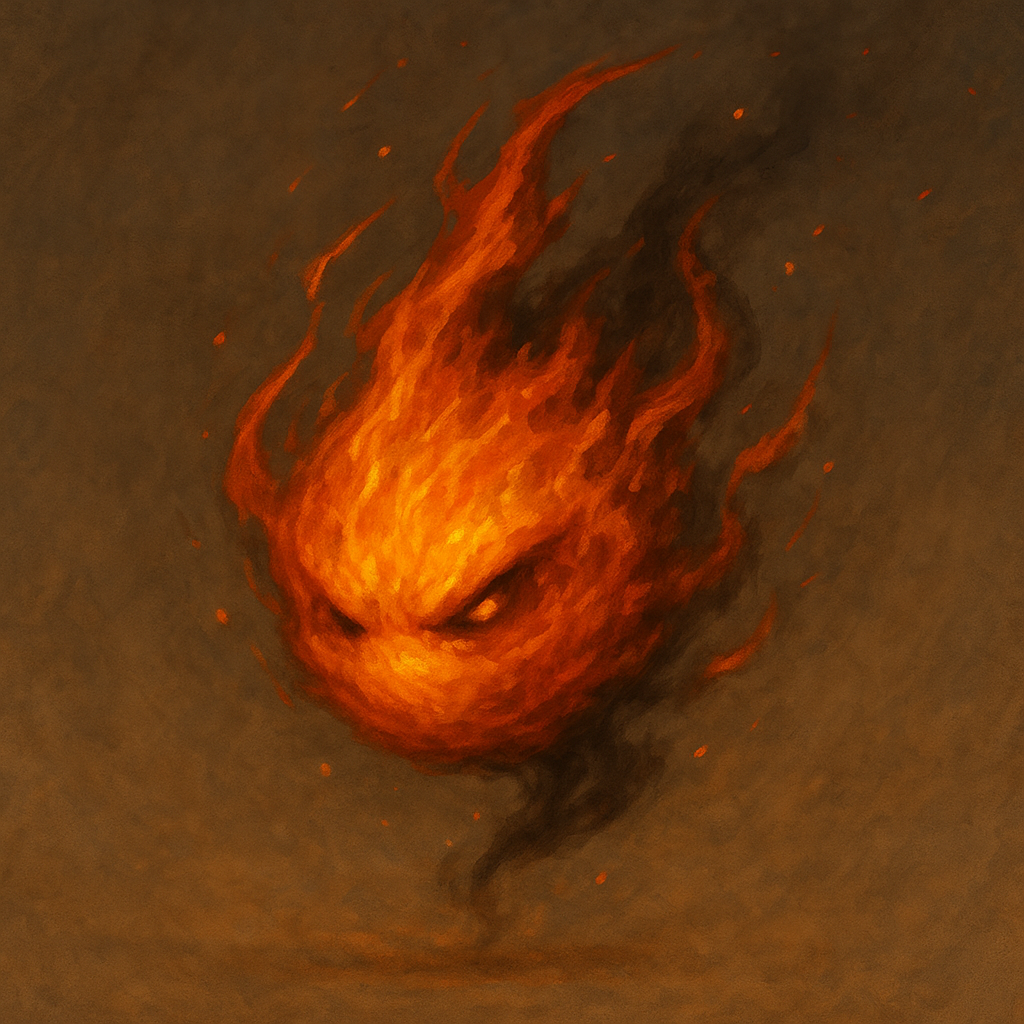
Yllanys and Seraphina unleashed bursts of frost and force, dampening the swarming assault. ISAC and Rayek carved paths through the fire with cold precision, cleaving through the darting elementals before they could strike. Kliedd wove between the shifting patches of solid ground, never staying still, eyes always searching for the next threat. Rather than attacking directly, he focused on keeping the others warned and mobile, shouting out sudden shifts in movement and pointing out flickers before they struck. The air stank of scorched ozone and ash by the time the last wisp shattered into cinders. Silence returned, but it was not peace—only an uneasy lull.
They pressed forward, but the message was clear: this place would not let them pass easily. The very air was hostile. The walls shimmered like they might ignite. And far below, something deeper waited.
Through Fire to the Gate
The next chamber held no ambush—but its dread was subtler. At the room’s center lay a massive summoning circle, carved into black stone now cracked and warped by lava bleeding through the floor. Though parts of it had melted and fallen away, the arcane pattern still pulsed faintly, emitting a glow that was neither comforting nor familiar. The color shimmered between blue-white and sickly green, an unnatural light that crawled across the walls like fog. The markings themselves writhed faintly, flickering with remnants of some once-living ritual.
The group moved cautiously around the edges, careful not to step too close. The circle had the look of something long-abandoned but not fully dormant—a spell that had died screaming, still echoing in its own ruin. Whispers of forgotten names seemed to hang in the heat, and a pressure built behind the eyes just from looking at the runes. No one lingered longer than necessary.
The final chamber of their descent was the worst yet. The temperature spiked sharply, well past endurance. Lava ran openly down the walls, casting the entire space in a flickering red glare. But worse was the air. It shifted from heat into poison—something invisible, caustic, and alive. Every breath brought pain. For those wearing armor, it was like being trapped inside a sealed oven. Movement slowed. Reactions dulled. The pressure grew unbearable.
As the group spread out to seek cooler space or a path forward, the lava shifted.
At first it was a ripple—subtle, like a tremor. Then the surface tore open in a geyser of fire, and from its heart rose the Inferno Serpent. It was vast and terrible, scales like molten obsidian, flame dripping from its fangs. Its body arched through the air like a whip of liquid heat, and its eyes burned with cruel, mindless purpose. It did not speak. It did not roar. It only rose to strike.
Inferno Serpent

And this is where the session ended.
Maps


