
20th of Elient of the year 1492
The Morning After the Impossible Dream — Fractures in Reality
The morning does not arrive gently, nor does it bring the quiet reassurance that comes with rest. Instead, it gathers them together in a space that should feel familiar—the dining room, the table, the routine—but none of it settles properly. Each of them arrives carrying something unspoken at first, the weight of a shared disturbance that lingers behind their eyes. What begins as idle complaint quickly reveals itself as something far more precise, far more aligned than coincidence would allow. The unease grows not from fear alone, but from recognition, from the slow realization that what each of them remembers is not separate, but shared.
“Don’t know about y’all, I had the worst dream last night. Like I see enough of y’all during the day.”
“I am not sure if that was a dream or other felt too real to be a dream.”
“It was very bizarre. So, we went on this quest involving dwarves… there was a druid… and then there was a bunch of like tentacly toothy things in a place that seemed freaking endless.”
“Zenith… it was a temple, a dark temple. Couldn’t make our way. We just had to keep going through.”
The details do not contradict—they reinforce. Each voice adds structure to the same place, the same movement, the same suffocating sense of being forced forward through something that refused to be understood. It is not the strangeness of the imagery that unsettles them, but the consistency. No one fills in another’s gaps incorrectly. No one misremembers. The fragments lock together too cleanly, forming a single experience retold from multiple vantage points. The dream does not dissolve under scrutiny. It solidifies.
Then the physical world betrays them.
“I woke up with a stone.”
After Kliedd reveals the stone, Byron immediately checks for the bracelet he had received before, groping for it with the expectation that it will still be there as it always was. “Oh wait, do I have the bracelet?” he asks, only to discover that it has not vanished so much as changed. What had once been a bracelet now circles his wrist as a tattoo, delicate and ornamental in shape, impossible to remove because it is no longer an object at all. “A tattoo oh, That’s odd,” comes the immediate reaction, followed almost at once by open admiration: “It’s very pretty. It’s very pretty. Very pretty.” The transformation is quiet, almost graceful, which only makes it stranger.
The stone itself offers no comfort. It is not inert, nor is it easily dismissed as some mundane object mistakenly carried from sleep into waking. It resists being treated as ordinary, its presence marked by subtle wrongness—a warmth that does not fade, a quiet pulse that suggests something within it continues to move. Its surface feels worn and ancient, as though handled by countless hands long before Kliedd ever touched it, and even after being brushed clean it still clings faintly to dust and soil. It does not explain itself. It simply remains there in his palm, heavy with implication.
The Return of Kieren — Ashes and Warnings
The conversation does not remain fixed on stones and markings for long before it shifts toward something far more immediate. The return of Kieren is not announced with ceremony or explanation, but rather folded into the discussion with a strange calm that does not match its significance. His absence had been tied to something far more severe than distance, something involving restraint and forces beyond their control, and yet now he is simply… back. There is no clear account of how it happened, only the acknowledgment that it did. That lack of clarity lingers in the air, tempering what should be relief with something more cautious, more measured.
“Kieran is back.”
“Very good.”
“It was a little bit out of my control, but I am grateful anyway.”
The exchange is brief, almost understated, but it carries weight. Gratitude is present, but it does not resolve the larger question of what allowed his return, or whether whatever took him is finished. The moment does not settle into comfort. It cannot. The conversation continues to move, pulled forward by a growing sense that too many things are changing at once.
That unease sharpens as attention turns to the state of the portals they had once sealed. What had been considered secured, contained, or at least delayed, is now showing signs of failure. The warning does not come as speculation, but as something already in motion.
“The uh portal we sealed… apparently that one is getting weaker.”
“The water portal?”
“Yeah… it seems like the dam is going to break eventually, and that will be the first one.”
The phrasing leaves little room for interpretation. A weakening barrier is not stable, and the comparison to a dam carries an inevitability that is difficult to ignore. It is not a question of if, but when, and perhaps how violently. The conversation shifts again, the implications settling quickly among them. What they accomplished before was never meant to last forever, and now the first signs of collapse are beginning to show.
That realization finds a more tangible form in Byron’s quiet observation.
“I woke up and I was sleeping on ash.”
His pillow, once whole, is now nothing more than ash beneath him, with no clear cause given and no sign of how the change occurred. The detail does not stand alone for long, instead settling into the growing list of things that no longer behave as they should. It is not explained, questioned, or resolved in the moment, only acknowledged.
The conversation does not stop, but it does not recover its earlier ease either. The ash remains part of the morning, just as the warning remains part of the day, both sitting quietly alongside everything else that no longer fits together as it once did.
Breakfast, Banter, and Dangerous Pickles
The kitchen fills not with comfort, but with motion—an almost stubborn insistence on normalcy as hands reach for pans, for plates, for anything that feels routine. The weight of the morning lingers in the air, but it is pushed aside with the scrape of chairs and the low murmur of voices finding something easier to talk about. Someone asks, almost offhand, “How do you like your eggs?” and the question lands like an anchor, simple and solid. “Typically hard boiled,” comes one answer, followed without pause by, “I would like mine fried, please,” and for a moment the room shifts, settling into something familiar. It is not peace, not truly, but it is close enough to pretend.
That fragile rhythm does not hold. Too many hands move at once, too many assumptions made without words, and what should have been a simple meal becomes a quiet mess of overlapping effort. Spices are passed without explanation, added without question, and whatever order might have existed dissolves into something far more careless. It happens in that space, in that moment where attention drifts just enough. Byron takes a bite without hesitation, without suspicion, and then stills as the taste catches up to him. The words follow immediately, sharp and unmistakable. “Oh shit.”
The change is instant. The room shifts with him, voices rising as the reaction takes hold just as quickly as the realization had. There is no easing into it, no gradual understanding—only the sudden certainty that something has gone very wrong. Movement replaces conversation, hands reaching, questions thrown out faster than they can be answered. In the middle of it, the explanation emerges, offered with a kind of reluctant familiarity that does nothing to make it better. “He basically goes out to the wilderness and picks up random spices… and makes pickles out of them.” The words hang there, absurd and entirely insufficient.
Grund’s name settles over the moment like something already known, already accepted in the worst possible way. This is not new, not entirely. It is simply the first time the consequences have landed this hard, this fast. The danger does not need to be explained further; it has already made itself known. And yet, even as the urgency begins to ebb, something else returns with it—something lighter, sharper, threaded through the edges of the moment. The absurdity creeps back in first, then the humor, uneven but persistent.
The kitchen does not empty. The food is not abandoned. Instead, the moment folds back into itself, the chaos settling into something almost recognizable. The earlier conversation returns in fragments, circling back as though it had only been paused. The question of eggs lingers, unfinished, absurdly important again in the wake of everything else. And somehow, that is enough.
Threads of the Past — What Still Waits Below
The meal does not end so much as it fades, plates left where they are as the conversation drifts away from food and back toward the weight that had never truly left the room. What had been scattered impressions and uneasy recollections begin to take shape as they are spoken aloud, each piece laid beside the others until a pattern starts to emerge. No one leads the discussion outright, yet it moves with purpose all the same, circling back to what they saw, what they felt, and what it might mean. The tone shifts again, quieter now, less frantic than before but far more deliberate. It is no longer about reacting to what happened but understanding it.
The chained presence at the heart of their shared vision refuses to be ignored, rising again and again as the one constant that ties everything together. Its significance stretches far beyond the dream, reaching back into a history older than any of them had considered relevant until now. One voice puts it plainly; the weight of the realization carried in the words themselves: “Whatever this chained entity is… it was related to the fall of Tyar-Besil seven thousand years ago.” The number alone is enough to still the room, but it is not left to stand alone. Another thought follows, quieter but no less certain, “I think that whatever it is… that is the chain that binds everything together.” The idea settles heavily, not argued, not dismissed, simply accepted as something that fits too well to ignore.
From there, the conversation widens, pulling in everything they have encountered, everything they thought they had already resolved. The elemental cults are no longer separate problems in distant places, but pieces of something far more interconnected. They begin to speak of them not as isolated threats, but as parts of a larger structure, something fractured but still functioning. “There may be internal fractures between those divisions inside the cult,” one observes, and the thought is met not with disagreement, but with recognition. Another voice adds, “As evidenced by the Air Cult… the murder suicide,” recalling the moment not as an anomaly, but as proof that something within those ranks is unstable, divided against itself.
Names and places begin to surface as the past is drawn back into the present. Feathergale Spire is spoken of not as a conquered location, but as something left unfinished, its presence lingering in memory with unanswered questions. The dwarves they had encountered before are brought back into consideration, their situation no longer resolved but suspended, waiting to be revisited. Even the teleportation circle—once a tool, a convenience—takes on new weight, its limited knowledge hinting at boundaries they had not fully understood at the time. Each thread they had once set aside begins to tighten, pulling back toward them with quiet insistence.
What had once felt like separate journeys now folds together into a single path, though that path is far from clear. The past does not sit behind them as something completed, but lingers just out of reach, waiting to be returned to. No conclusions are drawn, no final plan declared, but the shape of things is becoming harder to ignore. The pieces are not scattered. They have always been part of the same whole.
Market Day and the Illusion of Normal Life
When they step out into the streets, the world does not greet them with signs or omens or anything that might reflect what they now carry with them. Instead, it greets them with noise. The market is alive, already in full motion, voices rising and falling in overlapping calls as merchants set their wares before passersby who move with purpose and distraction in equal measure. The smell of cooked food drifts through the air, mixing with the sharper scents of leather, metal, and livestock, while carts creak and wheels grind over packed earth. Someone remarks, almost needlessly, “It’s market day today,” and the words feel strangely out of place against everything they have just experienced. Nothing here suggests anything is wrong. Nothing here reflects the fractures they have begun to see.
They do not remain together for long. The pull of small tasks and unfinished errands draws them apart in ones and twos, each slipping into the rhythm of the town as though trying to match it. Some make their way toward Iron Jaw, expecting the steady familiarity of work already underway, only to find something subtly, quietly wrong. The conversation there does not match their memory, the timeline does not align, and the realization arrives not with drama but with a simple correction. “Today’s only the twentieth.” The words land with more weight than they should, not because of what they say, but because of what they contradict. What they remember does not fit the day they stand in.
The feeling does not linger long enough to be examined fully, because the market continues to press in around them, insistent and unbothered. Stalls stretch in uneven rows, each offering something different, something louder or stranger than the last. At one edge, a familiar sight draws attention for all the wrong reasons—Grund’s stand, surrounded not by eager customers but by those recovering from their choices. The lingering effects of his creations are written plainly on those who had been curious enough to try them, a quiet warning that does little to slow the next person from stepping forward. Not far from there, another vendor calls out the virtues of exotic eggs, their shapes and colors strange enough to draw a crowd despite the earlier chaos in the kitchen.
Further along, a bookseller has laid out his collection with particular care, each title displayed as though it were something to be admired rather than questioned. The names alone are enough to turn heads, read aloud with a mix of curiosity and disbelief. “The Necromancer’s Extremely Obedient Boyfriend.” A second follows quickly after, “The Dragon Empress and Her Very Loyal Knights,” and then another, no less earnest in its presentation, “The Archmage’s Favorite Pretty Knight.” There is no shame in the display, no attempt to disguise what is being sold. The merchant treats each title with the same seriousness as any scholarly text, offering them without hesitation to anyone willing to take interest.

All of it unfolds beneath the same bright, indifferent sky. The market does not slow, does not falter, does not acknowledge anything beyond its own momentum. Whatever has shifted for them remains contained within their own understanding, unseen and untouched by the world around them. The noise continues, the trade continues, and life moves forward exactly as it always has, as though nothing has changed at all.
A Warning Carried Back — The Shape of What Has Not Yet Happened
The rhythm of the market and the noise of the street do little to soften what comes next. The conversation turns again, but this time it sharpens, drawing tight around something far less abstract than dreams or lingering impressions. Tarnick does not circle the point or dress it in uncertainty, but brings it forward plainly, anchoring everything they experienced to something real and immediate. “We’ve had a portent of the future,” he says, and the weight of it settles differently than anything before. This is not memory alone, not speculation, but a warning tied to a place, to people, to something that has not yet come to pass. The vision is no longer just strange—it is actionable.
The details follow, not all at once, but enough to form a clear and troubling shape. A mining expedition, dwarves working where they should be safe, and something waiting beneath them that should not be there. One name rises above the rest, not because of importance, but because of absence. “She was the only survivor.” Bryllyn Trollfist stands as the single thread left behind in what was otherwise complete loss, a detail that refuses to be dismissed as coincidence. The way it is spoken leaves no room for comfort, no suggestion that it might be exaggerated or mistaken. It is remembered too clearly, carried with the same certainty as everything else they saw.
The urgency builds quickly from there, not in raised voices, but in the quiet tightening of what must be done. If what they experienced is truly a glimpse of what lies ahead, then time has already begun to narrow around them. There is no sense of distance to it, no safety in delay, only the awareness that whatever happened before has not yet happened here. And yet, it feels close—too close to ignore. The question is no longer whether to act, but whether action will matter.
“We ended up going down into some temple. We came to when it was two days prior today.”
That single detail shifts everything. What they remember is not anchored in the past, but in something that has yet to unfold, and the gap between then and now is painfully small. The idea settles in unevenly, each of them turning it over in their own way, testing it against what they know and what they have seen. If they truly came from what lies ahead, then this moment—this day—sits before it, untouched, waiting.
What that means is left hanging between them. The possibility is there, unavoidable, that what they saw can be changed, that the outcome is not yet fixed. But alongside it comes another thought, quieter and far less certain—that what they remember may already include their own actions, that the path ahead may not bend so easily. The warning has been carried back, but whether it enough remains unanswered.
The Stones of the Elements — Gifts Without Guidance
The telling of the stones does not come all at once, but in careful fragments, each voice stepping forward to place another piece into something that already feels too complete to be coincidence. What had first been dismissed as separate dreams begins to align with unsettling precision, each account following the same quiet pattern—a journey, a place, a moment of stillness, and a stone waiting to be taken. There is no struggle in any of them, no resistance, no warning. Only the act of reaching out and claiming what had been set before them. One describes it plainly, the memory carried in the rhythm of the words themselves: “Vast, endless expanse of water. And as I was walking through, I came upon a pillar that held this small stone on it. And when I grasped it, the dream dissipated. But I continued to have the stone. Just a smooth white stone.” The image lingers, quiet and impossibly still.
Palewater Gem

Another vision follows, sharper, hotter, filled with motion that feels held back by something unseen. “There is an enormous forge carved in. To the side of a mountain, and as I approached, there was a pedestal with a red stone sitting on it. With almost magma flowing through the stone, and as I picked it up, everything in the forge paused. It was unlike anything I’ve ever seen before.” The pause in that moment—the way the forge itself seemed to halt—hangs heavier than the fire, as though the act of taking the stone had stilled something that should not be stilled. The third comes from beneath, from a place that does not burn or flow, but presses in with weight and quiet force. “When he approached. Post Boulder, it began cracking and it cracked. And this stone was in the middle of it. When he grasped it, he woke up.” The earth does not resist. It opens.
Not every account comes with such clarity. One voice offers something less defined, but no less telling. “I’ll say that I don’t i didn’t have any dreams, but my room was moist.” The detail is strange in its simplicity, lacking the shape of the others but fitting among them all the same. Together, they form something that no one can easily dismiss, the four pieces settling into place almost on their own. Someone says it aloud, giving it the form it has already taken. “Air, earth, fire, and water.” The words do not explain anything, but they name it, and that is enough to shift the room into a quieter understanding.
The stones themselves sit between them now, no longer imagined, no longer uncertain. They are real in the simplest and most troubling way, present without explanation, carrying something within them that cannot be seen but is clearly there. One of them moves to examine it more closely, settling into the task with intent. “I am going to sit while we’re discussing it and ritually cast identify on mine.” The others watch, waiting for something definitive, something that might tell them what they have been given. What comes back is not nothing—but it is not enough. “You do know it has a charge.” The words prompt more questions than answers. “One charge for something.”
Embervein Core
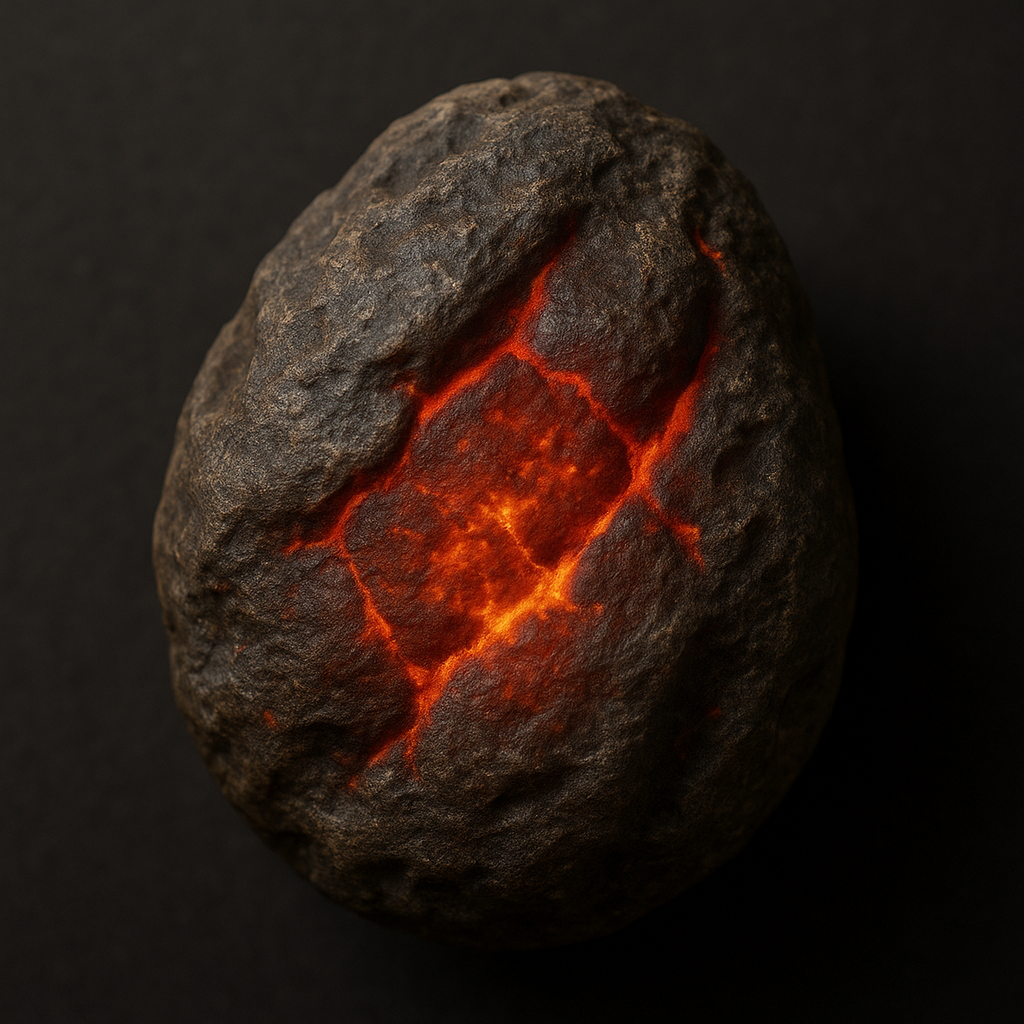
They turn the stones over, not physically alone, but in thought, testing what little they know against what they do not. Each one carries a different nature, something distinct and unmistakable once it is named. “The earth stone transmits transmutation.” The next follows without hesitation. “The air stone is conjuration.” Then, “Firestone is evocation.” And finally, “And the water stone is abjuration.” The pattern is as clean as the visions themselves, each aligned, each deliberate. These are not fragments of something broken. They are whole.
Earthen Heartstone

Curiosity pushes forward where understanding does not. “Anyone want to cast theirs?” The suggestion is met with immediate confusion. “What do you mean, cast it not in mouth?” The clarification comes quickly, though it offers little more certainty. “Like, just you know, go into the backyard and use the charge. See what happens.” The idea lingers for only a moment before it is set aside, not dismissed, but left unresolved. The truth is simpler than any of them would like. “No one knows how to turn it on.” The stones remain still, their purpose unspoken, their presence undeniable.
Whisperglass Stone

As the conversation turns, another thread emerges, pulling the stones into something larger than themselves. They are not the first of their kind, not the only objects tied to the forces they represent. “Each cult had a special weapon that was used to open the portal.” The memory sharpens as it is spoken, pieces of past encounters falling back into place. “If, like I suspect, we will need to go to the elemental planes at some point, we may need to acquire those weapons as keys to open those.” The implication settles quickly, linking what they now hold to what they have already seen.
The stones are not the only keys. They never were. Somewhere out there, still in the hands of those who guarded them, are the others—a dagger, a trident, and more that have yet to be named. The cults did not simply worship what lay beyond those portals. They controlled it. And whatever lies ahead will not be opened by these stones alone.
A Line That Does Not End — Blood, Steel, and Inheritance
The conversation shifts without warning, slipping away from strategy and speculation into something far more personal, far more dangerous in its certainty. It begins quietly, almost as an aside, but the words carry a weight that silences the room as soon as they are spoken. “One thing I have learned that my son is alive, and he controls a one of the houses of Waterdeep.” There is no disbelief in response, only a stillness, as the implications begin to unfold. It does not end there. “And he now knows that I am alive as well. He has been trying to find you.” The words settle heavily, and for a brief moment, the response comes in the only way it can, sharp and practical. “Do we need to lay an ambush?” The answer follows just as plainly. “He did kill me once. And tried to do it again.”
That last statement lingers, but it is not left alone for long. It is clarified, grounded in time with a precision that strips away any room for metaphor. “He succeeded in killing me three hundred and ninety-seven years ago.” There is no exaggeration, no flourish—only fact. The room absorbs it unevenly, the scale of it taking a moment to settle into something understandable. Someone attempts to frame it in simpler terms, almost searching for a way to make it less severe. “So, are saying that he’s alive, and holds a grudge for a long time?” The response is immediate, and certain. “He does; he has.” The weight of that answer does not come from its wording, but from the calm with which it is given.
What follows is not the story of a feud, nor even of a persistent enemy. It is something far more methodical, far more unsettling in its structure. “He has descendants, all of them… And every generation he seems to be… culling all of them and assuming the identity of one of them.” The explanation unfolds in pieces, each one worse than the last as the shape of it becomes clear. “And then living for another generation as that person. And then repeating the cycle.” There is a pause, brief but heavy, before the final thought is spoken aloud. “Over and over and over again.” No one interrupts. No one corrects it. The meaning does not need to be explained further.
It takes a moment before anyone speaks again, and when they do, it is with a kind of grim clarity that cuts through the silence. “Sounds like the family tree is a straight line.” The observation is simple, almost dry, but it lands with precision. This is not lineage as it should be. It is not inheritance passed down, but something taken, stolen, and worn like a mask. One will, one identity, carried forward by erasing everything that comes after it. The idea settles into place with a quiet inevitability, each piece fitting too cleanly to be dismissed.
There is more, of course. There is always more. “I just know that he inhabits a body of metal like mine.” That detail draws everything tighter, pulling the thread into something already familiar, already dangerous. The bodies they have seen, the constructs they have encountered, are no longer separate from this story. They are part of it. “We believe that the gnomes that originally built these bodies used the weave itself as a sort of flux. To protect the soul transferred into them.” The explanation carries a kind of careful understanding, something studied and pieced together over time. But it does not extend to what is happening now. “Alexander is not doing that and is probably corrupted himself more than I care to think about.” The difference is not subtle. It is the difference between preservation and decay.
From there, the connections begin to tighten, each thread pulling toward the others until they begin to overlap. “But somehow, someone connected to that family is also connected to the Bleeding Eye bandits.” The statement is met not with confusion, but with recognition. Another piece falls into place almost immediately. “The Bleeding Eye bandits are also all connected to the elemental cults.” The pattern emerges without needing to be forced, each part already aligned beneath the surface. Bloodline, bandits, cults—none of them separate, all of them touching the same unseen structure.
Bleeding. Eye Bandits

And beneath it all, something older waits, something that has been there long before any of them had begun to understand it. The final thread is spoken not with certainty, but with the weight of something that feels true regardless. “These warforged shells were connected to at least this chained entity, and they go back ten thousand years.” The number does not need emphasis. The scale speaks for itself. The same entity. The same temple. The same chains.
Old Roads, Old Enemies, and the Shape of the Past
The path backward is not taken lightly, but it comes all the same, drawn-out piece by piece as the present refuses to make sense without it. What had once seemed like a straightforward task—an escort, a journey with a clear beginning and end—now reveals itself as something far more deliberate. The memory is brought forward carefully, almost reluctantly, as though speaking it aloud might give it more weight than it deserves. “We actually met one of the current heirs of that house or scions of that house, and we escorted him to Red Larch many months ago.” At the time, it had felt like little more than another road to walk, another obligation fulfilled. Now, it sits differently, no longer isolated, but connected.
That connection deepens as the memory shifts to Amphail, where the first signs of something more complicated had already begun to surface. “In Amphail, We came across a plot to basically assassinate or kidnap, one of the local nobles, that being Nathan Axedredge.” The name lingers as the story unfolds, the details sharpening with each retelling. The road had not been empty. It had been watched, interrupted, shaped by forces that had been present long before they realized it. The attack itself had carried an oddness to it even then, something that had not fully made sense at the time but now returns with clarity.
Nathan Axedredge

“He conjured out of his big metal wagon something he called Death Guards.” The image rises easily—constructs pulled from within the wagon, unnatural in both form and purpose. “Death guards are mechanical constructs made of necromancy. Essentially, there is some sort of flesh and mechanical fusion.” The explanation follows the memory, giving it structure that had been missing before. It had been seen, understood in the moment only as danger, not as something that required deeper questioning. Now, with everything else laid bare, it feels different. “Was not a red flag for you?” The question is asked without accusation, but it carries its own answer. “Well, we didn’t know this at the time.”
Death Guards

What had been an ambush reveals itself as something more deliberate, more personal than it had first appeared. The threat had not come from outside alone, but from within the same bloodline. “There was a person that hired his guards to betray him, and that person was originally his older brother.” The betrayal does not stand alone, but folds into everything that has already been said about inheritance, about identity, about the way that line continues. It is not an isolated act, but part of something that has been repeating for longer than any of them had realized.
And behind that moment, behind even the betrayal, something else had been present, watching and waiting. “There was a man in black… That is the same guy that later killed my first shell in Red Larch by stopping time.” The memory sharpens there, narrowing into something precise and final. “So, plunging a dagger through the back of my head.” There is no embellishment, no need for it. The act speaks for itself, the image settling into place alongside everything else that has been uncovered.
Shadowy Figure

The pieces begin to align in ways that are difficult to ignore. The Axedredge family is no longer just a name tied to influence or position, but something unstable, something already compromised. “Whether it’s Nathan or whether it’s Drake or one of those three is either Alexander himself or soon going to be replaced by Alexander.” The uncertainty does not weaken the claim—it sharpens it, turning every possibility into a threat. There is no clear way to separate what is real from what has already been taken. “I don’t know how to tell which one Alexander would target to take over and kill the rest.” The problem is not simply knowing who the enemy is. It is knowing whether that enemy is already standing in front of them, wearing a face they have already trusted.
The Edge of Choice — To Act or To Wait
The conversation does not end with understanding. It turns, inevitably, toward what must be done, and there the certainty begins to fracture. What had been pieced together so carefully—the visions, the warnings, the threads tying everything into place—now presses against a single question that refuses to settle. The mine sits ahead of them, not in memory but in the world as it is now, untouched and unbroken. The discussion circles it cautiously at first, testing the edges of what they believe against what they can prove. Someone voices the image that lingers from what they saw, grounding the uncertainty in something concrete. “Manhole cover in the ground, like we saw before. Do you guys go in?” The response comes quickly, almost reflexive. “No, no, we don’t go in.”
That answer does not end the matter. It only shifts it, drawing out the deeper problem beneath it. “What does it tell us if we if we go there and it’s there or not there?” The question hangs in the space between them, unanswered at first because it has no easy answer. The argument begins to split along familiar lines, not of right and wrong, but of risk and responsibility. One voice pushes toward caution, toward restraint, unwilling to act on something that may not yet exist. Another presses back, insisting that uncertainty is not an excuse when lives may be at stake. The tension builds quietly, carried not in raised voices but in the weight behind each word.
“Reputation with Banmin and the dwarves, making sure that the mine is safe for the dwarves to return.” The reasoning is practical, grounded in what can be protected, what can be preserved. It is met with hesitation, with the reality of how it might appear from the outside. “If we go up there and there’s nothing, we look crazy.” That thought lingers only briefly before it is answered with something far less comforting. “We already do, considering that we supposedly traveled back in time.” The truth of it lands without resistance. Whatever standing they once had already been strained by what they know, by what they claim to have seen.
The discussion tightens around what can be done rather than what might be believed. A path begins to form, simple in structure if not in certainty. “I am saying, if we find it, we uh tell the dwarves, ‘Hey, there is this hatch in the middle.’” The idea is not to confront, not to descend, but to warn—to place knowledge where it might matter most. It is met with immediate resistance, sharp and instinctive. “Oh, oh don’t go there. Just don’t.” The words carry a different kind of caution, not about appearing foolish, but about stepping too close to something already known to be dangerous.
What settles out of it is not agreement, but compromise. They will go. They will look. They will confirm what they can and warn who they must. But they will not descend, will not repeat the path they remember, will not willingly step back into what they believe is waiting below. It is a plan shaped as much by restraint as by action, defined more by what they refuse to do than what they intend to accomplish.
Even as the decision takes form, something quieter works its way into the edges of the conversation, a doubt that no one can quite set aside. “Isn’t there also the possibility that they go back, the event could still happen anyways?” The question is not answered, only followed by another, darker still. “Or it could be the fact that we do this, causes it all to happen in the first place?” The thought lingers, unchallenged, and no one moves to dismiss it.
21st of Elient of the year 1492
Banmin and the Warning That Comes Too Early
The road to the Tomb Quarry is not long, but it carries a different weight now, each step taken with the quiet awareness that they may already be too late—or far too early. The quarry itself stands as it always has, carved stone and ordered labor set against the earth, unchanged and untroubled by anything they have seen. When they arrive, they do not linger at the edges or approach with uncertainty. The request is made plainly, carried to one of the soldiers stationed there, and passed along without question. Banmin is sent for, and for a short while, they are left to wait, standing in a place that gives no sign of what they expect to find.
When Banmin arrives, there is no urgency in his step, no sign that anything is amiss beyond the unusual nature of their request. His expression carries confusion more than concern, but he listens all the same, willing to hear what has brought them here ahead of whatever plan they had already begun to form. Before they can speak fully, he offers what he knows, unaware of how it will land. “They’ve not found anything besides old mining and minerals in there.” The words fall simply, matter-of-fact, and in doing so, they complicate everything. The mine is untouched. The danger has not revealed itself. The future they remember has not yet begun.
Banmin Glehuruhr

The absence of anything wrong does not ease the tension—it sharpens it. What they have seen does not align with what stands before them, and yet neither can be dismissed. The warning is given anyway, not with certainty that it will be believed, but with the understanding that it must be spoken. There is no evidence to point to, no visible threat to name, only the weight of what they know and the need to place it somewhere it might matter. Banmin does not interrupt, but the confusion remains, threading through his silence as he considers what is being asked of him.
The response, when it comes, is practical, shaped more by duty than by understanding. “I’ll let her know that you’ll be on your way at first light.” It is not agreement, not fully, but it is enough. The message will be carried. The warning will reach those who need to hear it, even if it arrives before the danger itself. There is no dismissal, no refusal—only a willingness to act within what can be done now. Another voice adds to it, grounding the moment in preparation rather than doubt. The words feel out of place in a quarry that shows no sign of threat, but they are spoken all the same.
When Banmin leaves, he does not carry certainty with him, only the burden of a warning that has no visible cause. The quarry remains as it was, unchanged, steady, and indifferent to what has been set in motion. They are left standing in that space between what is known and what is seen, where neither fully agrees with the other. The world has not yet shifted to match what they remember. The danger has not yet arrived. But it is coming.
The Cave in the Pass — Wolves, Filth, and a Night That Refuses to Matter
The decision to rest is not made out of comfort, but necessity, and so they turn back toward the cave carved into the pass—a place already marked by memory, though not a simple one. It is familiar ground, but not in the way any of them would prefer, tied now to something they have lived through and not yet lived at the same time. The approach is quiet at first, the wind cutting along the stone and carrying the scent of the pass ahead of them, but that quiet does not last. The cave is not empty when they arrive, and whatever has claimed it does not yield its ground without challenge.
The wolves come fast, not with hesitation or warning, but with the kind of direct violence that leaves no room for second thought. They surge from the cave mouth and the shadows beyond it, teeth bared, bodies low and driven by instinct rather than fear. Steel meets them without delay, movement replacing stillness as the space collapses into the chaos of the clash. There is no drawn-out struggle, no circling tension—only the sharp exchange of force as the pack presses in and is met in kind. In the middle of it, one voice cuts through, blunt and final. “I end the arguments.” The warhammer falls, and with it, whatever resistance remained, the last of the wolves collapsing into stillness as quickly as the fight had begun.
Wolves
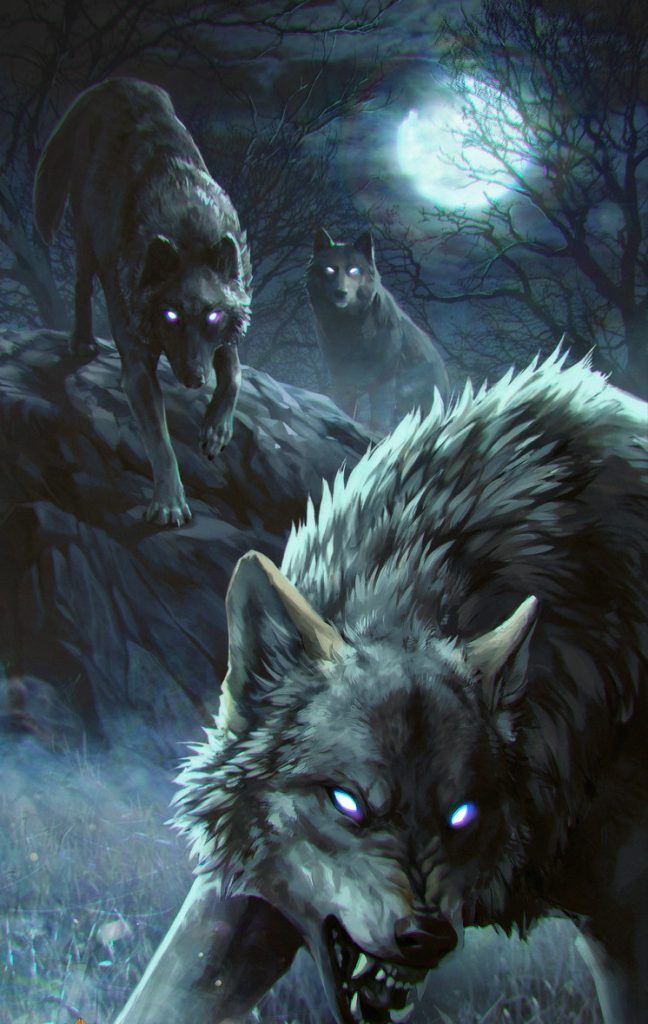
What remains is not victory so much as aftermath. The cave entrance is littered with bodies, the sharp scent of blood already turning heavy in the air as it mixes with something far less tolerable beneath it. There is a moment where no one moves, the tension bleeding out of the space as quickly as it had filled it. Then the voices return, uneven but familiar, threading humor through the exhaustion whether it fits or not. “I didn’t even get to hit anything,” comes the complaint, followed quickly by, “They all they did was bite.” The response that follows carries a dry edge, delivered as though it belongs anywhere but here. “You would say their bark was not as bad as their bite, correct?”
The work that follows is practical, if unpleasant. Pelts are taken where they can be salvaged, though not all are worth the effort, and the rest are dragged together and set to burn. The fire takes them quickly, smoke rising and curling out of the cave mouth as the smell deepens into something worse. The inside of the cave offers no relief. “The cave is empty, full of wolf shit, but you know it’s empty,” is said with a kind of blunt honesty that no one disputes. The response comes just as easily, dry and unhelpful. “I’ll put a sign up. Avoid the wolf shit.” It does nothing to improve the situation, but it fits the moment all the same.
They stay anyway. There is nowhere better to go, and the need for rest outweighs the state of the place. Watches are set, positions taken, and the fire is left to burn low at the entrance, marking the cave with smoke and heat. The night stretches out around them, but it offers nothing in return. No movement beyond the wind slipping through the pass, no sound beyond the quiet shifts of those keeping watch and the low crackle of dying embers. Time passes without interruption, without confirmation, without anything to suggest that what they expect is drawing closer. The hours slip by in uneasy stillness, one watch giving way to the next, until the night is gone and nothing has come with it.
The cave remains what it is—fouled, foul-smelling, and utterly still. The bodies burn down to ash, the smoke thins, and the night gives nothing back. No sign. No warning. No answer.
22nd of Elient of the year 1492
The Miners on the Road — Arriving Before the Past
The quiet of the pass does not hold for long after the last of the wolves falls. Smoke still curls from the smoldering remains at the cave mouth, and the smell has not yet had time to settle when something new cuts through it—the creak of wheels, the rumble of wagons, and voices carried along the stone. It comes not as a distant possibility, but as an arrival, immediate and undeniable. The road, which had been empty, now fills with movement, and the realization settles in before a word is spoken. The miners are here. Not later, not after the events they remember, but now, arriving at the exact moment the last echoes of the fight fade.
The wagons slow as they approach, the sight before them impossible to ignore. A blackened heap smolders near the cave entrance, the ground churned from the struggle, the air thick with the lingering scent of blood and smoke. Before anyone can shape the moment into something coherent, a red-haired dwarf woman is already moving, dropping from her wagon with a force that matches the tone of her voice. “What the fuck are you guys doing? What’s wrong with me cave?” The accusation lands before any explanation can take hold, sharp and immediate, leaving no room for careful introductions or measured words.
Bryllyn Trollfist

The response is no cleaner than the accusation. Voices overlap, explanations begin before others finish, and the entire exchange unravels into a tangle of mismatched understanding. “Well, the last time I met you—” begins one attempt, only to be cut off just as quickly. “You never met me.” The correction is immediate, certain, and entirely true from her perspective. Another gesture follows, vague but insistent, trying to anchor the conversation in something tangible. “Is this yours?” The answer comes back just as sharp. “No, I don’t have anything like that. Don’t bullshit.” The frustration grows, not from hostility alone, but from the impossible gap between what is known and what can be proven.
The explanation only grows more tangled as it continues, the conversation slipping further out of alignment with each attempt to correct it. “I just got the shit kicked out of me by a bunch of wolves,” Tarnick says, the frustration in the words cutting through the moment as he pushes back against what is being assumed. The contradiction is immediate, almost absurd in its clarity against what lies right in front of them. The response does not attempt to soften it, gesturing instead toward the unmistakable evidence still smoldering at the cave’s edge. “Don’t mind the giant smoking pile of wolf swag.” The proof is there—burning, reeking, undeniable—and yet it does nothing to settle the argument. Instead, it sharpens it, each side speaking from a different version of events that refuse to align.
The conversation spirals further, caught between memory and reality. “I saw what you were doing. Picking on some poor wolves.” The accusation lands with certainty, as though the scene has already been judged and decided. “They attacked first.” The reply comes just as quickly, grounded in what just happened rather than what is being assumed. “Oh yeah, running up to their lair?” she fires back, the logic twisting into something that refuses to meet in the middle. “To their lair.” The repetition only deepens the divide, each word circling the same point without ever touching it.
And then the truth slips out, not as a revelation, but as a statement that only complicates everything further. “This is where we stayed the night last time we.” It hangs there, unfinished, until the question cuts in. “When you met me in the future?” The answer comes without hesitation. “Yes!” The reaction is immediate, incredulous, and entirely justified. “Then it wasn’t your lair, was it?” The logic is sound, but it solves nothing. Instead, it opens another thread that cannot be closed. “How’d you know we met you in the future?” The answer follows just as quickly. “You said so!” The correction is instant. “No, I just said I’ve met you before.” And then, with a kind of stubborn finality, “Exactly!”
The moment hangs there, unresolved, the truth caught somewhere between what has happened and what has not yet begun. The miners stand in a world that still makes sense to them, while those before them carry knowledge that does not belong to this moment. Neither side is wrong. Neither side can prove it. And between them, the road remains exactly as it was, even as everything about it has changed.
A Warning That Cannot Be Proven
The confusion does not resolve cleanly, but it narrows, slowly drawn toward something that can be tested rather than argued. Words begin to give way to something more tangible, something that does not rely on memory or belief. The question comes out of that shift, direct and strangely specific, cutting through the overlapping voices. “So, what’s wrong with me mine?” It is not a question anyone present would think to ask without reason, and that alone gives it weight. There is a pause, brief but noticeable, as the dwarf woman looks between them, measuring the strangeness of what she’s hearing against the certainty in how it’s being asked.
Her answer is not defensive, only confused, but willing. “Yes, let me just let me show you.” There is no hesitation in the gesture that follows, no sign of injury, no hidden damage waiting to be revealed. What she shows is exactly what it should be—nothing missing, nothing altered, nothing wrong. The confirmation lands quietly, but it lands fully. The future they remember has not yet taken hold here. Whatever horror they witnessed, whatever loss marked that moment, has not happened.
And yet, something shifts in that moment, subtle but undeniable. “My conscience can rest easy,” is said with a lightness that does not quite match what sits beneath it. Relief is there, unmistakable, settling into the space now that the worst of what they feared is not yet real. But it is not a complete relief, not the kind that allows something to be forgotten or dismissed. It carries with it an edge, a quiet awareness that this moment exists on borrowed time.
They stand there with proof in front of them—living, breathing, unharmed—and it does not resolve anything as cleanly as it should. If this is the moment before everything breaks, then nothing has been prevented. Nothing has been changed. The future still exists somewhere ahead of them, waiting to unfold exactly as they remember it. And all they have done is arrive early enough to see that it has not yet begun.
Paths Diverge — But Not Cleanly
The moment does not end when the truth is confirmed; it stretches, shifts, and reshapes itself into something far less certain. The dwarves do not simply accept what they have been told and move on, not when the warning itself carries so many unanswered questions. Suspicion lingers in the air, quiet but firm, grounded not in hostility but in the practical instincts of those who have spent their lives surviving what others overlook. The question comes with that weight behind it, steady and direct. “So, what you are telling me now is the danger has passed?” It is not an accusation, but it demands clarity all the same.
The answer does not ease that tension. “The danger happens tomorrow.” The words land plainly, but they fracture the moment rather than settle it, pushing the problem forward instead of resolving it. The response comes quickly, sharper now, the logic of it too obvious to ignore. “Then why aren’t you going to the mine to inspect it to ensure something’s there?” There is no hesitation in the question, no room for deflection, only the expectation that action should follow warning. The answer that follows carries none of the certainty the question demands. “Because we’re on a time crunch.” It is true, but it is not satisfying, and everyone present knows it.
That gap does not go unnoticed. The dwarves exchange looks, the kind that say more than words would, before pressing forward in a different direction. “Oh, then you wouldn’t mind if we follow you?” The offer is not framed as defiance, but it carries its own kind of insistence. The response comes without resistance, but not without consequence. “Of course.” Agreement does not resolve the underlying tension; it simply redirects it. The answer that follows settles into that space with quiet resolve. “Great, considering what we faced when we were last there, we could probably use your help.” It is not entirely trust, and not entirely skepticism—something balanced between the two.
The road forward is no longer theirs alone to choose. The dwarves will act as they see fit, guided by their own judgment rather than the uncertainty of others. There is no argument to be won here, no authority to assert that would change that. The group prepares to move on, but the path ahead has shifted in ways that cannot be easily undone. Plans that felt fragile before now carry the added weight of others who may or may not follow them into whatever waits next.
When the time comes to settle, what little rest can be taken is divided not just by necessity, but by choice. The dwarves remain with their wagons, keeping to their own space, their own routines, unwilling to share in the discomfort that has already been claimed. The difference is noted, not with bitterness, but with a kind of dry acknowledgment that fits the day too well. “They sleep in their wagon.” The reply follows without hesitation, sharp enough to cut through the fatigue. “I am sorry, he’s going to stew in dog shit cave.” It lingers there, the humor small and uneven, but real in a way that nothing else has been.
In a day where time has refused to behave, where certainty has slipped through their grasp at every turn, that small exchange holds its place. The cave still reeks. The road still stretches ahead. And for the moment, that is enough.
Into the Mine — Where Nothing Waits
The mine reveals itself without resistance, without omen, without any of the dread that had settled so heavily in their expectations. It stands exactly where it should, its entrance cut cleanly into the stone, the passage beyond worn by honest labor rather than anything hidden or unnatural. The dwarves linger behind them at a cautious distance, close enough to witness what unfolds, but far enough to let the others take the first step into whatever might be waiting. The air is still, undisturbed, carrying none of the weight they remember from before. There is no distortion in the light, no tremor beneath their feet, no sign of the hidden threshold they are certain should be there. It is, in every visible way, exactly what it claims to be.
They move forward anyway, drawn not by what they see, but by what they expect to find beneath it. The intent is cautious, deliberate, shaped by memory and the weight of what they believe waits below. That intent does not survive contact with reality for long. “So, the three of them are bumbling forward,” someone mutters, and it proves immediately accurate. The first misstep echoes louder than it should, metal scraping against stone, followed by another and another. “Clang clang bang bang clang!” rings out through the tunnel, the sound bouncing back at them in mocking repetition.
“Shut up!” comes the sharp response, though it does little to contain the noise that follows. Armor shifts where it shouldn’t, boots strike uneven ground, and bodies collide in ways that turn quiet intent into something almost theatrical in its failure. Whispered corrections are anything but quiet, and each attempt to recover only adds another layer to the noise. It is not stealth. It is persistence disguised as effort, carried forward with more determination than success.
And still—nothing answers them.
No movement stirs in the darkness ahead, no hidden presence reacts to their approach, no sign emerges of anything waiting beneath the surface. The echoes of their missteps fade slowly, swallowed by the mine until only the faint scrape of movement and breath remains. The deeper they go, the more the space refuses to change, each turn and passage shaped by labor rather than secrecy, by purpose rather than concealment. The tunnels branch as they should, worn and practical, carrying no trace of anything buried beneath them. When they reach the central chamber, it offers no revelation, only more of the same—open space giving way to additional paths, each one leading further into nothing of consequence. What lies before them is not a hidden descent or a forgotten threshold, but a working mine, quiet and unremarkable, its emptiness as complete as it is undeniable.
There is no hatch.
No hidden descent. No threshold into something older and far worse. The stone remains only stone, the air only air, the space empty of anything that should not be there. The place offers no resistance because there is nothing to resist. It is a mine, nothing more, nothing less, standing exactly as it always has, untouched by the future they carry with them.
The Dwarves — A Truth Without Evidence
The mine offers nothing, and somehow that makes what comes next even harder. Standing in a place that refuses to match their memories, they are left with only words to bridge the gap, and words alone feel thin against something that has not yet happened. The dwarves gather close enough now to see clearly, their expressions sharpened by equal parts skepticism and patience. They are not dismissive, not outright, but neither are they ready to accept what has no proof. The explanation begins anyway, carried forward not by certainty, but by necessity. “I’ve already taken measures to protect you within the cavern,” is offered first, as though action might lend weight where evidence cannot.
That only raises more questions, not fewer. “You’ll see a chalk outline. It’s a magic circle. Just don’t dig there.” The instruction is specific, grounded in something real, even if the reason behind it remains invisible. The reply comes quickly, practical and unyielding. “So where is the thing that’s supposed to be here?” It is the simplest question in the world, and the hardest to answer. The response that follows attempts to close the gap but only widens it. “Oh, I took measures to prevent it from coming from showing up in the first place.” It hangs there, balanced between confidence and contradiction, offering a solution that cannot be proven and a success that cannot be seen.
So, they tell the rest of it, not because it will be believed, but because it must be said. The story unfolds in pieces, each one adding to something that sounds less possible the more complete it becomes. “Some mysterious hatch appeared in the ground that led to an ancient drow temple,”comes first, anchoring the memory in something physical, something that should have been here. “And locked within it was also a druid who had been lost in there and gone mad.” The image sharpens, growing more vivid as it continues, less like a warning and more like a recounting of something already endured. “He emerges, lashing out, attacking anyone nearby in the form of a owlbear.”
The details do not soften as they go on, only deepen. “We weren’t able to find a single body; lots of blood, but no body.” That part lingers, heavier than the rest, because it carries with it the absence of closure, the kind that cannot be argued away. The dwarves listen through all of it, their silence not empty, but measured. They do not interrupt, but neither do they rush to agreement, weighing what they hear against what they see in front of them. What they have been given is a story that should leave marks, and yet the ground beneath them remains untouched.
When the response finally comes, it does not reject the story outright. “I hadn’t already said that you guys were trustworthy, I’d have some questions for you.” The sentence trails just enough to leave those questions unspoken, but not absent. Then, after a moment, the acceptance settles in—not fully understood but not dismissed either. “But I’ll take it.” It is not belief, not entirely, but it is enough to move forward.
Trust carries the rest where reason cannot. It is not the story that convinces them, nor the absence of danger that supports it, but the presence of someone they recognize. “We’ve got Zenith with you, so I know a dwarf wouldn’t lie to me about this kind of thing.” That is what holds the moment together, not the impossible explanation, but the weight of shared identity and quiet certainty. In the absence of proof, that is enough.
Nothing Happened — And That’s the Problem
The mine yields nothing, and that absence settles over everything that follows like a weight that cannot be easily named. The dwarves move through their work as they always would, checking stone, marking veins, speaking in the steady, practical rhythm of people who know exactly what they are doing. There is no hesitation in their steps, no shadow of doubt in their actions, no sign that anything has threatened this place before now. The ground remains unbroken, the air untouched, the space entirely what it appears to be. Even the place they warned of—the spot marked, the place they insisted should not be disturbed—sits quietly, offering no sign that it holds anything at all. What they see is safety, plain and unremarkable, and that should have been enough.
It is not.
Because what stands before them does not match what they carry with them. The memory does not fade simply because the world refuses to reflect it, nor does it soften under the weight of contradiction. They remember the hatch, the way it opened into something far older than the mine itself, something carved in a style that did not belong to dwarves or surface stone. They remember what waited below, the violence of it, the way it left no clean end behind. “We weren’t able to find a single body; lots of blood, but no body,” echoes in the space between them, not spoken again, but present all the same. That memory stands in quiet opposition to everything they now see.
The dwarves accept what they have been told well enough to continue, their trust given where proof cannot be, but even that does not resolve what lingers. The ground has not opened. The threat has not emerged. The story they were given has no visible anchor in the present, and yet it has not been dismissed either. It exists alongside reality, neither replacing it nor yielding to it, an unconfirmed truth waiting for something to force it into alignment. No one says it outright, but the question hangs there all the same, unspoken and persistent.
If nothing has happened, then nothing has been stopped.
The possibilities do not need to be listed aloud to be understood. This could be the result of their presence, a change made simply by arriving before they were meant to. It could be that they are too early, standing in a moment that has not yet caught up to what they remember. Or it could be something far less forgiving, something that waits just beyond this stillness, unchanged and inevitable. The calm of the mine does not reassure—it delays.
And beneath all of it, there is a quiet understanding that settles without needing to be voiced. The absence of danger is not the same as its end. The mine remains silent, the stone unbroken, the dwarves alive and unaware. But the memory of what should be here has not gone anywhere. It waits, just as the mine does, unchanged and patient.


